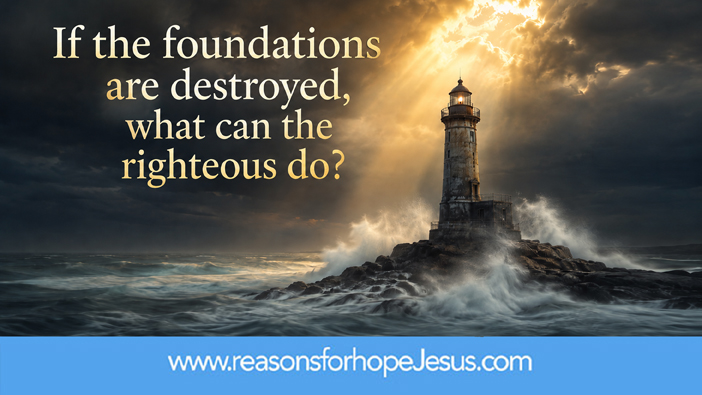
“If the foundations are destroyed, what can the righteous do?” — Psalm 11:3
In every generation, believers look out at the world and feel the ground shifting beneath their feet. Wars and rumors of wars, political polarization, moral confusion, economic uncertainty, crumbling trust in institutions, and heartbreak inside our own families can make it feel as if the very foundations of life are collapsing. Psalm 11 gives words to that experience and asks the burning question: “If the foundations are destroyed, what can the righteous do?”
The Burning Question of Psalm 11
Psalm 11 opens with a bold confession: “In the Lord I put my trust.” That is where David starts. But immediately, other voices interject—counselors urging him to run: “Flee as a bird to your mountain.” The picture is vivid: the wicked have bent their bow, fitted their arrow to the string, and are shooting in the dark at the upright in heart.
That ancient scene feels remarkably current. The “bent bow” and “arrow in the dark” describe more than just physical threats. They suggest unseen hostility, subtle attacks, and mounting pressure against those who want to walk with God. Christianity is no longer widely respected; all too often it is not merely tolerated but ridiculed and openly opposed.
Into such a setting comes the central question of the psalm:
“If the foundations are destroyed, what can the righteous do?” (Psalm 11:3)
“Foundations” here refers to morality and social order—the underlying beliefs about truth, justice, decency, and integrity. When those foundations erode, a whole society groans. For many, that is how our modern world feels.
Psalm 11 does not answer the question by recommending escape. It answers by calling believers to a faith that is rooted in who God is, what He has done in the past, and what He promises for the future.
From Despair to Confidence: The Two Stanzas of the Psalm
The psalm falls into two movements.
- First stanza (vv. 1–3): the counsel of fear and flight. “Flee like a bird.” The wicked are armed and hidden; the righteous feel exposed and outmatched. The question about destroyed foundations rises from that threat.
- Second stanza (vv. 4–7): the response of faith. David turns from the voices telling him to flee and looks upward. His confidence is not in political solutions, military strategy, or human advice. It is in the person, character, and power of God Himself.
The move from the first stanza to the second is the move every believer must make in times of cultural or personal crisis: from focusing on the size of the threat to focusing on the God who sits above it.
The psalm offers five pillars of a well-built faith for standing strong when earthly foundations feel like they are crumbling.
1. There Is Security in God’s Sovereignty
“The Lord is in His holy temple, the Lord’s throne is in heaven.” (Psalm 11:4)
While the foundations on earth shake, the throne in heaven does not. God’s rule has not weakened, and He is not surprised by the events that trouble us.
A small view of God will always produce big anxieties—anxieties that can crush us. But Psalm 11 magnifies the Lord, reminding us that He is in His holy temple; He reigns in heaven. He is transcendent—above the tumult—and yet intimately engaged with His world.
When we are tempted to say, “Everything is out of control,” faith answers, “No—everything is out of my control, but nothing is out of His.” When everything feels like it is falling apart, we can be assured that everything is falling into place according to God’s good purpose and plan. Confessing God’s sovereignty is not escapism; it reorients our perspective toward trust in our gracious God.
2. There Is Comfort in God’s Concern
“His eyes behold, His eyelids test the sons of men.” (Psalm 11:4)
The psalmist uses striking imagery: God’s “eyelids” test humanity. It pictures God squinting, narrowing His gaze to see with sharp clarity. He is not indifferent or distracted. He sees with piercing precision what His people are facing.
This seeing is not passive observation. It is watching with purpose. God uses difficult seasons to expose what is fragile in our lives and deepen what is our needed strength—our trust in Him. Trials reveal where our trust truly lies. They strip away illusions of self-sufficiency and remind us that His grace is sufficient.
For believers, God’s testing brings purposeful formation. He desires to make His children mature—complete, lacking nothing. Many of the qualities we admire in faithful saints—steadfastness, compassion, and wisdom—were formed in the furnace of trial.
Knowing that God both reigns and cares allows us to interpret hardship as part of His wise and loving work.
3. There Is Clarity in God’s Holiness and Hatred of Evil
“The Lord tests the righteous, but the wicked and the one who loves violence His soul hates.” (Psalm 11:5)
We are comfortable saying God hates sin, but Scripture also speaks of God’s hate of some people. This “hate” does not negate His love for all. God sent Jesus to die for the whole world, so that all can repent and come into relationship with the living God. The hate this psalm speaks of is more of a holy opposition to those who persist in ruthless evil.
In a world that often celebrates what God condemns, it’s easy to soften or blur His holiness. Psalm 11 reminds us of God’s moral outrage at violence, injustice, deceit, and cruelty. He is in no way neutral toward evils like genocide, exploitation, abuse, or systemic oppression. We should share in His outrage over such things and speak His truth about them.
Having a robust sense of God’s holy hatred of evil keeps us from trivializing sin and magnifies our gratitude for grace. It also assures us that the moral outrage we feel regarding evil is not misplaced; it reflects the heart of a just God.
4. There Is Justice in God’s Judgments
“Upon the wicked He will rain coals; fire and brimstone and a burning wind shall be the portion of their cup.” (Psalm 11:6)
This is not license to avenge ourselves against our adversaries. It declares that final justice belongs to the Lord. One of the great tensions of the Christian life is living in a world where evil often appears to succeed. Psalm 11 steadies us with the reminder that the story is not over.
God’s judgment is not an angry response. It is the necessary response of holiness to rebellion and cruelty. For victims of great wrongs—war crimes, persecution, long-term oppression—the promise of divine justice gives precious hope, knowing God will not allow evil to have the last word.
Holding onto God’s ultimate judgment and His promise to one day make all things right keeps us from despair and from taking justice into our own hands. We can labor for justice now, knowing that perfect justice is anchored in God’s character and future action.
5. There Is Hope in God’s Presence and Righteousness
“For the Lord is righteous, He loves righteousness; His countenance beholds the upright.” (Psalm 11:7)
While the wicked face God’s fiery judgment, the upright are the object of His gaze and favor. “His countenance beholds the upright” can also be translated, “The upright will behold His face.” Clearly, the relationship is intimate.
The ultimate hope of the righteous is not merely that evil will be punished, but that they will enjoy God’s presence. A strong faith knows that God is in control, God sees, God is righteous, and in Christ, He welcomes us into His presence.
Jesus is the One who bore judgment in our place, the One who justified us with His righteousness, and the One who will return to set all things right. Our security is not in stable circumstances, but in a steadfast Savior.
So What Can the Righteous Do?
When the foundations appear to be crumbling, Psalm 11 does not call the righteous to denial or despair. It calls them to re-anchor their confidence in God. Practically, that means at least four things:
- Refuse panic; declare Jesus to be your refuge. Like David, begin with, “In the Lord I take refuge.” Say it in prayer; sing it in worship; remind your own soul of it when headlines scream, and anxieties rise.
- Interpret trials through God’s care. Instead of asking, “Why is this happening?” ask, “What might God be forming in me through this?”
- Take holiness and grace seriously. Let God’s hatred of evil deepen your hatred of your own sin and increase your gratitude for the cross. Preach the gospel to yourself daily, knowing that in Christ, you are fully forgiven.
- Live as a preview of the coming kingdom. Because you know God is sovereign, concerned, holy, just, and gracious, live differently. Live with integrity, compassion, courage, and hope.
The foundations of this world may indeed be shaking. In fact—they have been since the fall of Adam. But the foundation under the righteous—those who trust in the character and promises of God—remains unshaken. A strong faith can stand firm because it is anchored to the God whose throne is in heaven and whose eyes never leave His people.
<*}}}><

Have our resources inspired or encouraged you on your faith journey? If so, we invite you to partner with us and receive a free gift. Learn more here.
*******
Do You Know Jesus?
The Bible clearly states that everyone has sinned and fallen short of God's glory (Romans 3:23). It also emphasizes that while the wages of sin is death, God offers us the incredible gift of eternal life through Jesus Christ our Lord (Romans 6:23). Don’t wait—find hope and redemption!
*******
In Case You Missed It:
Top Ten Articles in 2025
- Was Jesus CRUCIFIED on Wednesday, Thursday, or Friday?
- ONLY ONE LIFE, Twill Soon Be Past – by C.T. Studd (1860 – 1931)
- How are the Shepherd’s ROD and STAFF Different?
- Jesus’ Last Days TIMELINE: the Cross and the Resurrection
- The Meaning of NUMBERS in the Bible?
- How was Jesus Like a Worm? What’s the CRIMSON (OR SCARLET) WORM in Psalm 22?
- What are the FOUR Different PRESENTATIONS of Jesus in the Gospels?
- Did The Wise Men Arrive 12 DAYS AFTER JESUS’ BIRTH? Or Was It Much Later?
- The Meaning of COLORS in the Bible?
- Where did OT Saints go at death? ABRAHAM'S BOSOM? Where was that?

Bible Windows: 2025's Top Ten Videos (biblewindows.com)
-
- Only One Life, ‘Twill Soon Be Past – Video
- Memorial Day Tribute- Children Who Said Goodbye to Their Fallen Hero
- A Hidden Message in the Bible’s First Word – Genesis 1 “In the BEGINNING”
- Singing the Promises of God
- Stepping Out of the Boat
- Parallels in the Deaths of Stephen (Acts 7) & Charlie Kirk
- “Footprints in the Sand” Poem in Song
- Songs in the Night in the Valley of Weeping
- The Devil Went Down to D.C.
- Echoes of Eden
2025's Top Videos on YouTube
- Memorial Day BAGPIPES TRIBUTE: Amazing Grace
- RISE AND SHINE and Give God the Glory, Glory!
- JOHN WAYNE ~ WHY I LOVE AMERICA
- Sidney Poitier - sings "Amen" from Lilies of the Field
- Hark! the Herald Angels Sing -- CHARLIE BROWN Christmas
- Not by Might, Not by Power, But BY MY SPIRIT says the Lord (Zechariah 4:6)
- I Heard the Bells on Christmas Day, by Henry Wadsworth Longfellow, performed by Casting Crowns
- WERE YOU THERE When They Crucified My Lord?
- PAUL HARVEY: THE BIRDCAGE
- How Many Kings Stepped Down from Their Thrones
*****************
2025's Top Ten "Words of Wisdom from the Cloud of Witnesses."
Much can be learned from those who have gone before us in the faith. Explore our Cloud of Witnesses category, featuring words from departed saints now with the Lord in glory. Their words continue to equip and encourage us to this day. 
- ONLY ONE LIFE, Twill Soon Be Past – by C.T. Studd (1860 – 1931)
- THE COMING PRINCE, by Sir Robert Anderson, 1894
- What's the Story Behind "There is a Fountain Filled with Blood by William Cowper
- "Immanuel" -- A Poem by Charles Spurgeon (1834-1892)
- Prayers from Billy Graham
- “The Love of God is Greater Far” by Frederick M. Lehman (1917)
- Who Was Robert Robinson? What’s the Story Behind “Come Thou Fount”
- 24 Reasons Why I Love America, by John Wayne (1907-1979)
- The Hound of Heaven, a poem by Francis Thompson (1859–1907)
- 40 Quotes from Frederick Buechner (1926-2022)
This remains one of our most fun and most viewed pages.
Get equipped with encouraging and empowering Biblical truth and wisdom from Reasons for Hope*Jesus.